“The sky is definitely red!” A classmate spoke, “That’s impossible. The sky has always been blue, and my teacher said it was true.” If we overheard two kindergartners talking about the color of the sky, we wouldn’t be surprised to hear them disagree. We all agree that the sky is blue, don’t we? Well, that is, until the sky isn’t blue. In other words, we accept a truth until we hear additional truth. The sky is red, sometimes. The sky has many hues, in truth. The sky is definitely not blue in the middle of the night in the United States. Truth be told, the sky is red. Sometimes. As mature readers of Scripture, we must be aware of oversimplistic perspectives.
Truth be told, Genesis 1:1 is an ancient sentence. Always. Not sometimes. Genesis 1:1 states, “In the beginning, God created the heavens and the earth.” The first sentence of our Bibles definitely reveals truth, though we may be unaware of its ancient meaning. Significantly, Genesis was originally written in Hebrew. Genesis 1:1 has only 7 words, not 10, and they are Hebrew words.
בְּרֵאשִׁית בָּרָא אֱלֹהִים אֵת הַשָּׁמַיִם וְאֵת הָאָרֶץ (Right to Left: Bereshit bara Elohim et hashamayim v’et ha’aretz). These are the seven words: Bereshit (In the beginning), bara (created), Elohim (God), et (object marker), (the skies), v’et (object marker), ha’aretz (the land). The Hebrew conjunctions et and v’et are in the original Masoretic Text (the authoritative Hebrew text of the Old Testament).
We see the single Hebrew word, hashamayim, the skies, is translated as the heavens. The heavens is correct. The KJV doesn’t translate the word hashamayim into a plural word, though. The KJV uses the singular heaven. This confuses modern English readers. Heaven, to a modern reader, is exclusively spiritual. It’s the realm believers enter after death. Eliza Hewitt was a prolific hymn writer. In 1898, she penned the ever familiar “When We All Get To Heaven.” Most of us are accustomed to separating Heaven from Earth because we’ve been taught that Heaven is the destination Jesus preaches.
Genesis 1:8 states that God called the expanse Heaven. Heaven is the same Hebrew word as heavens in Genesis 1:1. Thus, even the English word Heaven is plural if read in Hebrew. Huh? Genesis 1:1 isn’t explaining modern science. Genesis 1:1 is a summary. Ancient readers and hearers are discovering a different theological version of creation. Ancient Near Eastern cultures believed their own creation accounts. Genesis, while true, wasn’t the sole narrative for civilization.
We’re getting closer to the truth about the skies. If you noticed, the English translation calls an expanse Heaven. The expanse is named raquia רָקִיעַ in Hebrew, or a solid dome beaten out to keep the waters above it in check.
So, pausing for a moment, what does Genesis speak of? Obviously, Genesis doesn’t describe a disembodied or postmortem location moderns believe to be Heaven, but simply the place above dry land where birds fly. The raquia is the dome above the sky. How do we know? Genesis 1 continues to speak.
Genesis 1:9 is translated: And God said, “Let the waters under the heavens (הַשָּׁמַיִם hashamayim) be gathered together into one place, and let the dry land appear.” Also, Genesis 1:14–18: “And God said, ‘Let there be lights in the expanse of the heavens to separate the day from the night. And let them be for signs and for seasons, and for days and years, and let them be lights in the expanse of the heavens to give light upon the earth. And it was so. And God made the two great lights—the greater light to rule the day and the lesser light to rule the night—and the stars. And God set them in the expanse of the heavens to give light on the earth, to rule over the day and over the night, and to separate the light from the darkness. And God saw that it was good.” How can these lights exist in a disembodied, non-physical world? They don’t. So, we are hearing an ancient account of creation. That means we need to reorient. What we may have thought was ordered truth concerning an afterlife, Genesis isn’t addressing.
Genesis appears to provide functional meaning for the skies, the seas, the dry land, the stars, sun, and moon. Each serves God’s purposes. God controls everything. Then, which part does humanity play in this divinely controlled world? [That’s coming up soon.]
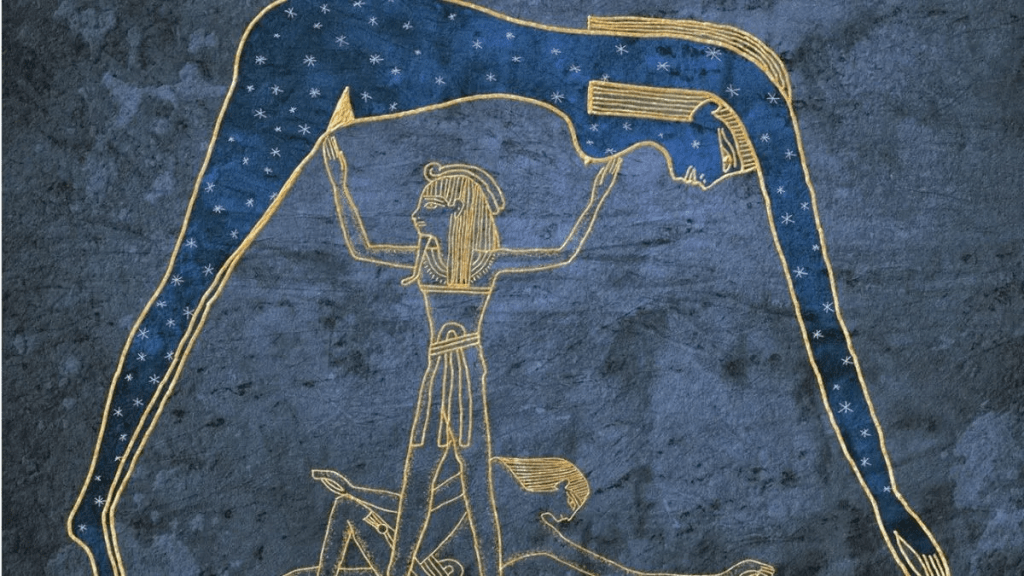
{Genesis attributes all things in creation to one true God, whereas Israel’s contemporary cultures definitely had polytheistic explanations for creation. Egypt’s sky goddess, Nut, is depicted as forming the heavens, similar to the description in Genesis 1.}
This is just a taste of hearing Genesis’ truth about God and creation. The margins of our Bibles need a lot of expanding in order to begin grasping and processing the meanings intended by the authors of the Bible.


Leave a comment